
Patient Registries: What’s Design Got to Do with It? · Part 2 of 2
Conducting a Pre-mortem: Where to Look and Act
A pre-mortem helps reveal the conditions a patient registry will need to succeed. Organizing potential sources of pressure helps identify where vulnerabilities and risks may lie, and where to watch and act as the registry develops.

At a glance
Look for pressure, not just failure
A registry operates within changing people, workflows, technologies, resources, priorities, and demands. Pressure develops where those conditions make the registry harder to operate or sustain.
Consider data in and value out together
Getting data into a registry has a cost. What comes back out is what justifies it. Pressure can build on either side of that relationship.
Organize what the pre-mortem uncovers
Use six broad areas to locate potential pressure: ownership, timing, process, friction, scope, and value.
Let the source point toward the response
The framework is not only a way to classify risks. Where pressure originates also helps identify where to watch and where action may be needed.
Under Pressure
In Part 1, we invited the reaper in and used a pre-mortem to imagine a failed patient registry. The goal was to better understand the full space in which the registry must operate, the factors that need to come together for it to succeed, and the places where that success may be fragile.
Now we need a way to characterize and organize what that exercise turns up.
A patient registry sits within a changing environment of people, workflows, technologies, resources, competing priorities, and demands on attention. Those elements do not merely surround the registry. They interact with what the registry is asking people and systems to do, sometimes supporting that work and sometimes making it harder.
Pressure forms at those points of resistance: the forces that make a registry more difficult to operate as intended or more difficult to sustain over time.
Some pressures are present from the beginning; others emerge over time. Some are obvious. Others are quieter, accumulate gradually, and can interact in ways that magnify their effects. A registry can remain operational while the pressures underneath it continue to build.
The Data In, Value Out Ratio
One of the most common ways pressure develops is through the relationship between data going in and value coming out.
Data in. Getting data into a registry requires work:
- collecting
- entering
- transferring
- checking
- following up when needed
- continuing to do all of that over time
Value out. At the other end, the value returned can span several broad areas:
- participant benefit
- clinical care
- research
- administrative and operational work
- organizational decision-making
Neither side of the ratio has an ideal amount on its own. A registry can ask a great deal of the people involved and remain sustainable if enough value returns. Even a modest amount of work can begin to feel excessive when the benefit is delayed, difficult to access, or largely invisible.
To get a sense of the pressure, look at both sides of the ratio together: the factors that make getting data in more burdensome, and the factors that affect the amount, timing, and visibility of value coming back out.
That pressure is not always obvious at the beginning.
Scale changes the equation.
What felt like a minor inconvenience at 50 participants may become a substantial burden at 5,000. A manual process that worked at one site may become difficult across twenty. A delay that seemed harmless during startup becomes more consequential once people begin depending on the information being available at the right time.
As the ratio shifts, the pressure often shows up first in how the work feels.
On the data-in side, the message often sounds like:
This is harder than it should be.
Definitions are unclear. Forms are long. Interfaces are difficult to use. Collection does not fit the natural workflow. Too much effort goes into correction and verification. Tasks remain manual even when they seem like they should be automated.
On the value-out side, the message sounds different:
This is not helping me enough to justify the effort.
Analysis takes too long. Useful information arrives after the decision has already been made. Participants experience the registry mainly as a place to enter data. Systems do not connect well. Outputs never progress much beyond raw numbers.
Eventually, people begin doing their own math:
Is what I am getting from this registry worth what it is asking of me?
Participants ask it. So do coordinators, clinicians, researchers, sites, and organizations.
The answer does not suddenly flip from yes to no. Instead, signs that pressure is building begin to accumulate.
- Missing data increase.
- Follow-up becomes less consistent.
- Complaints about workload grow.
- Data entry falls behind.
- More participants miss appointments or drop out.
Those signs tell us that the ratio between data going in and value coming out may be shifting. They do not tell us why. The cause can come from many different sources, and often from several acting together.
In the pre-mortem, the next step is to think through what those underlying sources might be.
Six Places to Look
A pre-mortem can produce a long list of things that might go wrong. To make that thinking more useful, it helps to organize the possible sources of pressure into six broad areas. Five bear on the cost of getting data in, and the last on what comes back out.
1. Ownership
Who is responsible?
Every registry depends on things happening. Information gets collected. Activities get completed. Problems get identified. Outputs get produced. Responsibility for those activities may belong to a participant, coordinator, clinician, device, external system, automated workflow, or some combination of them.
Ownership is more than naming who or what is responsible for a task. It also includes how that responsibility is assigned, whether it is visible to the people involved, how it is distributed, how it passes from one person or system to another, and who is accountable when an expected activity does not occur.
Ownership becomes a source of pressure when responsibility is unclear, assumed, poorly distributed, left to someone remembering what needs to happen, or concentrated in a single person, role, or system. Work can be missed, duplicated, delayed, or quietly absorbed by whoever is willing to pick it up. It can also stop altogether when the knowledge needed to keep it going lives in only one place. The coordinator who left in March may have been the only person who knew that follow-up surveys were supposed to go out on the first of every month.
When something fails, the problem can be compounded if no one can determine who or what was responsible, or if the knowledge required to keep the work going was never shared or made visible.
- Who owns it?
- Is that responsibility visible?
- What happens when it changes hands?
- If the activity does not occur, can we determine who or what was responsible?
2. Timing
When does the work occur?
Beyond date and time, timing encompasses the events, dependencies, and conditions surrounding when something occurs. It includes what triggers an activity, what needs to happen before or after it, how related activities are coordinated, who needs to know when action is required, and how the registry keeps track of whether the work happened when expected.
Activities often depend on one another. If even one step is delayed or missed, the activities that depend on it may also be disrupted. A reminder may arrive after it would have mattered. Information may reach a clinician after the relevant decision has already been made.
- When should this be collected?
- What starts the activity?
- What does it depend on?
- What needs to happen next?
- Who needs to know?
- How will we know if the sequence has been disrupted?
3. Process
How does the work get done?
Registry activities must fit inside the lives of participants and staff, and inside clinics, research programs, organizations, and systems that are already busy.
Process looks at whether those tasks fit within the workflows that already exist. The best starting point is to understand how people and systems already work, then look for ways the registry can fit into that work rather than imposing a new workflow to satisfy the registry.
A process that looks perfectly reasonable on a flowchart can become something very different at 4:30 on a busy clinic afternoon.
- How will this task be done?
- Where does it fit in the work that is already happening?
- What must change for it to work there?
- Where is the registry asking people or systems to adapt when the registry should have adapted instead?
4. Friction
How difficult is the work to perform?
Friction is the effort, complexity, inconvenience, or frustration of doing what the registry requires. The important questions are where that burden sits, how often it is repeated, who absorbs it, and what happens as it accumulates.
A step that is only mildly inconvenient once can become a real source of pressure when it is repeated across many people, visits, sites, or years.
As that burden builds, people start changing how they work. They take shortcuts. They delay the task. They create workarounds. They may eventually stop doing the activity altogether. Those changes are what later show up as missed data, delayed work, weaker participation, and poorer quality.
- Where is the work difficult?
- Where is effort being added again and again?
- Who is absorbing that burden?
- What is most likely to become harder to sustain over time?
5. Scope
How much are we asking the registry to do?
Scope pressure usually arrives one addition at a time. A new variable, form, or activity may make sense on its own. Together, those additions increase the amount of work the registry requires.
The question is whether that growing workload is matched by the capacity available to support it: staff time, expertise, funding, technology, and how much of the work can be automated rather than performed manually.
A registry with strong resources and automation can support a broader scope than one that depends heavily on manual effort. Pressure begins when the work being added starts to outrun that capacity.
- How much work does each addition create?
- What people, resources, and technology are available to support it?
- How much can automation carry?
- Is that capacity keeping pace with what is being added?
6. Value
What does the registry give back?
Value is what comes back to justify the investment of time, information, attention, effort, and resources. The issue is whether enough value reaches the full range of people and groups being asked to sustain the work.
That return can take different forms. Participants may receive better care, personalized health information, education, feedback, or incentives and other benefits of participation. Clinicians and staff may get better information for decisions, less administrative work, easier coordination, or time back. Researchers may get usable data, more efficient research activities, and a clearer path to analysis. Organizations may gain better visibility, operational support, and information they can use to plan and improve.
Pressure builds when the people doing the work receive little in return, or when what they receive arrives late, is difficult to use, or is disconnected from what they need.
- Who is expected to benefit?
- What are they supposed to receive?
- How soon will they receive it?
- Where does effort outpace the value returned?
Where to Look, Where to Act
Most registries will feel some degree of pressure across these areas. Some of it remains of minor consequence. Some of it grows enough that it must be watched and managed as part of the conditions in which the registry operates.
The six areas give a frame of reference for that work. They help us see where vulnerabilities may lie, and they also point toward the kind of attention the registry may need. A problem in ownership sends us back to responsibility and handoffs. A problem in timing sends us back to triggers, sequence, and communication. The other areas do the same: the place you are watching is also the place you may need to act.
This is where the pre-mortem does its real work. It gives us a structured way to think about what might get in the way of success, where risks may sit, and what kind of response is needed.
We do not leave the exercise with only a long list of things that could go wrong. We leave knowing where to look and where to act.
Put it to work
Pressure
Look at Data In and Value Out together.
Identify what the registry is asking of participants, staff, clinicians, researchers, sites, and systems, and what each receives in return.
Think about what happens at scale.
Ask what changes when participants, sites, years, forms, or activities multiply.
Six places to look
Test each pressure area.
Work through ownership, timing, process, friction, scope, and value rather than relying on an unstructured list of possible failures.
Look for interactions.
A problem may not belong neatly to one area. Consider how pressures can reinforce one another.
Action
Identify what should be watched.
If a vulnerability could threaten the registry over time, decide whether there are early signs that can be monitored.
Connect the source to the response.
Use where the pressure originates to help determine where design changes, monitoring, automation, resources, or other intervention may be needed.
A useful pre-mortem does more than tell you what might go wrong. It helps you know where to look and where to act.
All parts in this series

Patient Registries: What’s Design Got to Do with It?
The possibilities for patient registries have never been greater, and neither have the design choices. This series explores how to frame the registry, work through the tradeoffs, and put it to work.
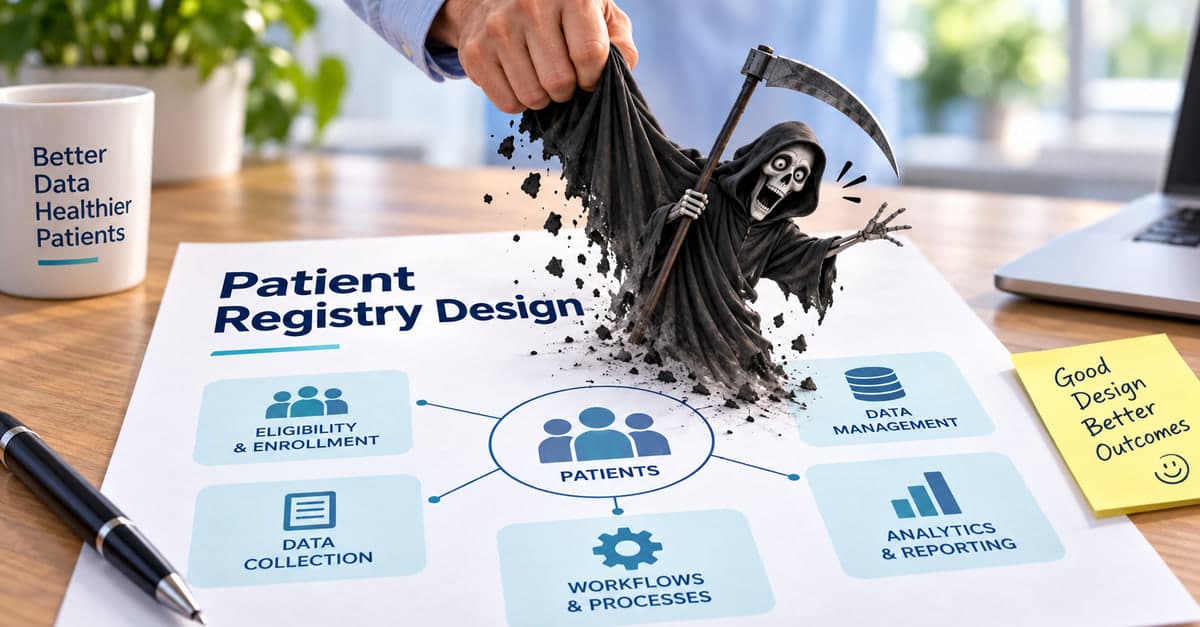
Patient Registry Pre-mortem: Removing the Grim from the Reaper
A pre-mortem asks you to imagine that your patient registry has already failed and work backward to understand why. The exercise helps widen the design space, uncover vulnerabilities, and reveal the broader range of factors that need to come together for a registry to succeed.
Conducting a Pre-mortem: Where to Look and Act
A pre-mortem helps reveal the conditions a patient registry will need to succeed. Organizing potential sources of pressure helps identify where vulnerabilities and risks may lie, and where to watch and act as the registry develops.
Designing something like this yourself?
Tell us what you are building and we will show you how it maps onto Studytrax.
Get started